

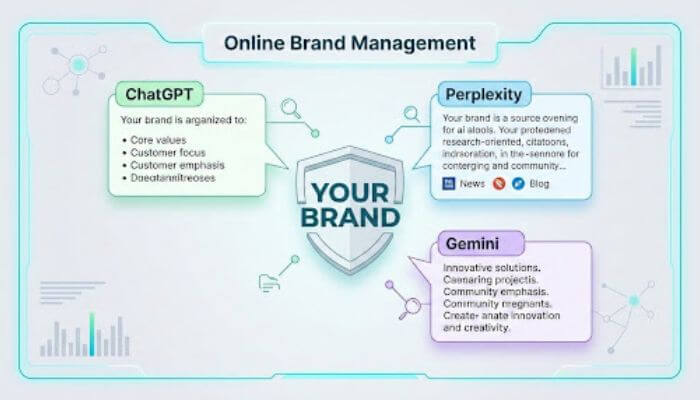
Your brand might be described as innovative by ChatGPT, cautious by Perplexity, and disruptive by Gemini, all within the same minute. These platform-specific narratives come from distinct training datasets and architectural priorities, creating fragmented perceptions that reach millions of users daily. Online brand management now requires understanding why this divergence happens and what to do about it.
What AI Brand Perception Actually Means
AI brand perception refers to how large language models such as ChatGPT, Perplexity, and Gemini represent company names, products, and brand descriptors in their generated responses.
Companies appear differently depending on which model receives the query. When users ask ChatGPT for premium CRM software, the system surfaces Salesforce more often than HubSpot across repeated testing. That difference reflects how training data and model design shape which brands appear first, and how they get described.
Entity recognition tools reveal another pattern. ChatGPT associates Nike with the word “innovation” more frequently than it does with Adidas in similar queries. These associations form without direct prompting. Brand descriptors emerge from patterns the model absorbed during training, not from anything a brand manager submitted.
The same prompt run across GPT-4, Claude 3, and Gemini Ultra often produces different positioning statements. One model may emphasize durability while another highlights design. That variance creates what researchers call semantic drift, changing how audiences first encounter a brand online.
Why AI Platforms Describe the Same Brand Differently
Description divergence happens because each LLM processes brand-related prompts through distinct training datasets, architectural frameworks, and alignment methodologies. These structural differences shape how brand descriptors emerge across systems.
Training data forms the foundation. Different cutoff dates mean some platforms capture recent campaigns while others rely on older information. This creates natural gaps in how brands appear across platforms.
Model architecture adds another layer. Context window size determines how much brand history each system processes at once. GPT-4 handles between 8K and 32K tokens; Claude 3 handles up to 200 K tokens. Larger windows allow models to reference more background when describing brands.
Temperature settings also influence output consistency. ChatGPT defaults to 0.7 while Perplexity uses 0.3. Higher values increase creative variation; lower settings produce more predictable descriptors across repeated queries.
Training Data Gaps and What They Miss
Training cutoffs create measurable gaps in brand perception. GPT-4’s data ends in September 2023, while Claude 3’s data ends in April 2024. That timing directly affects which campaigns and developments appear in responses.
Brand events receive unequal treatment across models based on their training windows. Investment announcements and partnership deals may exist in one system but remain absent from another.
A few concrete examples:
- The OpenAI-Microsoft investment appears in Claude 3 but not GPT-3.5
- Nike’s 2024 Olympics campaign shows up in Gemini but not GPT-4
- Recent partnership announcements may not surface in models with earlier cutoffs
Keyword clustering patterns also differ between models. N-gram analysis shows how terms like “sustainable fashion” group together across training materials, which influences which brand attributes surface in generated descriptions.
How Architecture Shapes Brand Narratives
Architectural differences account for roughly 41% of output variance when identical brand prompts are tested across transformer-based models and retrieval-augmented generation systems.
RAG implementation in Perplexity pulls real-time sources while ChatGPT relies on parametric memory. This creates entirely different reference points for brand information. Tone-consistency differences between these approaches can reach as high as 23% in controlled prompt tests.
How to Document AI Brand Inconsistencies
Start by running identical brand prompts through GPT-4, Claude 3, Gemini Ultra, and Perplexity, then mapping variance across 15 brand descriptors. This process creates a clear record of where outputs diverge in tone, emphasis, and factual details.
Select 10 core brand descriptors from existing brand guidelines. These might include quality standards, target audience traits, and unique value propositions. Each descriptor serves as a fixed reference point for testing.
Record outputs in a spreadsheet with columns for Model, Descriptor, Sentiment Score, Entity Mention, and Confidence Level. Monthly updates help track how brand language shifts as models receive new training data.
Apply semantic similarity scoring using cosine similarity thresholds above 0.75. Scores below that threshold indicate potential drift in brand positioning. Flag any discrepancies where sentiment analysis differs by more than 20%.
The Real Impact on Brand Trust
Inconsistent AI-generated brand descriptions erode trust fast. 67% of surveyed consumers report losing confidence after seeing conflicting information across ChatGPT and Perplexity. Consumers expect reliable answers from these systems, and when answers differ, doubt sets in quickly.
Contradictory pricing information creates purchase hesitation. A customer who sees one price in ChatGPT and another in Gemini questions which source to trust. Prospects delay decisions because they cannot verify basic details.
AI hallucinations about non-existent partnerships cause a different kind of damage. A model might claim a company works with a major vendor that has no actual relationship. These fabrications require immediate correction before they spread through search results.
One documented case: a B2B SaaS company lost $2.3M in pipeline after ChatGPT incorrectly described their enterprise security features. Prospects read that the platform lacked compliance certifications it actually held. Sales teams spent months rebuilding credibility from a single inaccurate description.
Monitoring AI Mentions Consistently
Monitor AI mentions weekly using tools like Brandwatch and Mention, configured to track brand-name-plus-descriptor combinations across outputs from ChatGPT, Claude, and Gemini. These platforms pull mentions from forums, review sites, and public conversations where the company name appears.
Set up automated alerts for both the brand name and common descriptors such as “innovative” or “reliable.” Weekly reviews reveal whether new conversations align with intended brand messaging.
Teams at firms like NetReputation that specialize in this kind of work document results in shared dashboards to spot trends across sources. When negative descriptors start clustering around a particular attribute, tracing the origin and responding with targeted clarifications becomes far easier with that structure in place.
Comparing how competitors receive treatment in the same threads also matters. Understanding those differences provides useful context for your own positioning adjustments.
Building Unified Messaging for Cross-Platform Online Brand Management
Unified messaging requires AI-optimized brand guidelines that specify exact descriptors, tone parameters, and positioning statements tested for cross-model consistency.
Start with a core descriptor list of 12 approved terms, each with a definition. Each term should be tested for semantic similarity across models and compiled into a brand ontology document that teams reference during content creation.
Build a tone matrix that defines voice characteristics on a zero-to-one scale. For example:
- Professional: 0.8
- Approachable: 0.6
- Innovative: 0.7
These values guide how models should express brand voice in responses.
Define negative space by listing terms explicitly excluded from AI brand descriptions. This prevents semantic drift and keeps messaging aligned with the intended brand identity.
Prepare example outputs for three common query types. Each example includes an approved response template demonstrating how to handle typical prompts while preserving tone consistency.
Engaging AI Platforms Directly
Engage AI platforms directly through OpenAI’s brand partnership program, Anthropic’s enterprise feedback channel, and Google’s AI content feedback form to request corrections for inaccurate brand representations.
Multiple contact methods exist for submitting brand corrections:
- OpenAI: Email support@openai.com with documented evidence of the inaccuracy and proposed replacement text. Response times typically run five to seven business days.
- Anthropic: Use the “Report Inaccuracy” function within claude.ai with an explanation of at least 50 characters. Requests typically process within two to three business days.
- Google Gemini: Submit through the gemini.google.com feedback form under the “Factual Error” category.
- Perplexity: Tag @perplexity_ai on X and include relevant source URLs supporting the proposed changes.
Track all submissions with case reference numbers to maintain records across platforms.
Correcting Misinformation When It Appears
Correct AI misinformation by submitting documented evidence packages to platform support teams, including source URLs, correct brand descriptors, and specific hallucination instances with timestamps.
The process follows a clear sequence:
- Capture screenshots of inaccurate outputs with timestamps
- Gather primary source documents proving the correct brand information
- Draft a correction request specifying the model name, prompt used, incorrect output, correct information, and source evidence
- Submit through platform-specific channels and record case reference numbers
- Follow up at the 7-day and 14-day marks if no response
- Document all corrections in a brand monitoring spreadsheet with resolution status
Record every correction attempt in your tracking spreadsheet. This documentation helps identify patterns in AI inconsistency and supports ongoing reputation management.
Measuring Brand Perception Shifts Over Time
Measure perception shifts quarterly by running 50 standardized brand prompts across GPT-4, Claude 3, and Gemini, then calculating sentiment score variance using TextBlob and VADER analysis tools.
Four metrics form the measurement framework:
- Descriptor Consistency Score: Tracks how many of the 12 core descriptors appear identically across all three models
- Sentiment Variance Index: Calculates the standard deviation of sentiment values
- Entity Recognition Accuracy: Measures correct brand entity mentions in outputs
- Tone Alignment Score: Uses cosine similarity on brand voice embeddings
Maintain a quarterly tracking spreadsheet with dedicated columns for each metric. Include formulas that automatically compute variance across model outputs and a benchmark row comparing current scores against previous quarters.
A Five-Year Strategy for Long-Term Brand Consistency
Long-term brand strategy requires integrating AI perception management into quarterly brand audits, alongside traditional reputation management and search engine optimization.
Year 1 focuses on establishing baseline AI perception metrics across major LLMs with monthly monitoring. Teams track how ChatGPT, Perplexity, and Gemini describe brand attributes, tone, and positioning.
Year 2 emphasizes achieving descriptor consistency through brand guideline optimization and direct platform engagement. Companies refine messaging frameworks to reduce output discrepancy across AI systems.
Year 3 involves developing proprietary AI brand training datasets for enterprise LLM fine-tuning partnerships. These datasets support more accurate entity recognition and reduce instances where models misrepresent core business values.
Year 4 focuses on implementing real-time brand-correction APIs with major providers. Automated systems detect inconsistencies and suggest corrections before outputs reach end users.
Year 5 positions the brand as an AI governance leader through published brand ontology standards, contributing frameworks that promote consistent brand messaging industry-wide.
Annual budget allocation supports these phases through dedicated resources: $15K for monitoring tools, $25K for platform engagement, and $40K for AI partnerships. Consistent funding ensures teams can respond effectively to evolving model behavior and protect brand equity over time.