

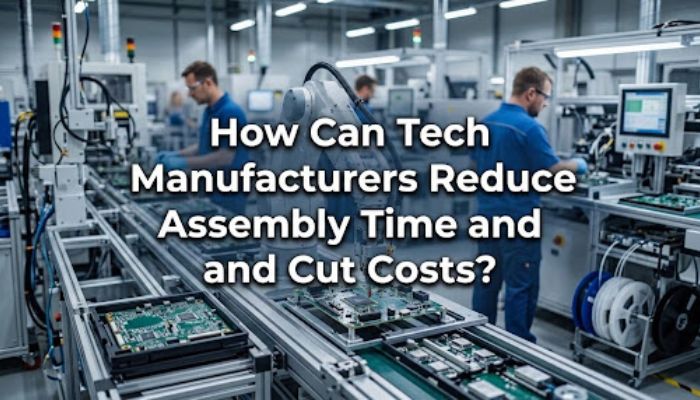
If you’ve ever watched a production line grind to a halt because of a bottleneck no one caught early enough, you already know how expensive inefficiency can be. To tech manufacturers, each minute on the assembly floor is directly converted into increased costs, and in an industry with a low margin and no one slowing down the pace of competition, this is an issue that you simply cannot dismiss.
The good news? It does not necessarily imply an enormous redesign to reduce the assembly time and costs. Sometimes, it is just a matter of smarter choices, improved procedures, and where to concentrate your efforts.
Start With the Design, Not the Floor
The majority of the manufacturers seek production floor savings. But the point of leverage? It is upstream during the design.
Design for Manufacturability (DFM) is what it looks like: the design of products taking into consideration the assembly process. When engineers create production oriented designs they remove assembly headaches even prior to their occurrence.
- Consider splitting big and complicated assemblies into smaller, modular sub assemblies.
- Simpler routing paths.
- Ready made modules that do not need specialized programs or training.
Complexity of wire routing is an unexpectedly expensive offender. Fewer wires, fewer routes, and standardized connectors not only save on material costs, but also save real time on each unit produced. Take that in thousands of units and the savings are quickly amassed.
Lean is not a Buzzword, It Works
Assuming that your team is not already operating some form of lean manufacturing, it is worth considering. The basic concept is paradoxically easy: discover what adds value and eliminate all that does not.
That is, removing waste in:
- Motion: Workers reaching, walking, or searching to find tools.
- Waiting: The time spent between process steps.
- Inventory: Excessive production (tie-up inventory).
Practical models such as 5S (sort, set in order, shine, standardize, sustain) provide production teams with a tangible point of origin not a hypothetical game.
One of the most surprising aspects of any manager: small, consistent changes are the ones that usually have the most significant impact as opposed to dramatic ones. Kaizen continuous, incremental improvement has produced quantifiable improvements in cycle times and defect rates in myriads of tech plants.
Cross Train Your Team and Rethink Your Shifts
Flexibility of labor is underestimated. By allowing your production personnel to work in more than one capacity, you will no longer waste time by having to cover shifts and unplanned absences. Cross-training does not necessarily need to be intensive, sometimes just a few hours a month per employee would suffice to create significant redundancy.
One more low hanging fruit is shift optimization. Most manufacturers are currently taking advantage of ERP data to match labor more accurately to the production cycles, saving them unnecessary overtime expenses without sacrificing production. It is not to get more out of people but rather to eliminate paying time that is not spent working.
Outsource the Specialized Stuff
The following is a question that should be asked honestly: ought your team to be doing everything in house?
In more complicated interconnect work, collaborating with a specialist cable assembly service allows your internal personnel to work on the aspect of the assembly process that they can actually contribute to. One specialist does the sourcing of materials, prototyping, testing and manufacturing of a product and in many cases, at a cheaper unit price than doing so within the company, due to their volume buying power and specialized equipment.
This is particularly applicable with the increasing complexity of tech products. Whereas it is not realistic to expect a generalist production team to manage precision interconnect work with the same effectiveness as a specialist, the trade-offs in quality are real.
Automate the Right Things (Not Everything)
Automation has become a bit of a divisive issue either the manufacturers are hoping it will fix everything or they are rejecting it as costly. The truth is more subtle.
The automation wins are a result of focusing on the appropriate bottlenecks. The natural candidates are repetitive tasks that have:
- Low variation
- High volume
- Quantifiable cycle time
Automated inspection systems, packaging lines, and maintenance alert systems do not replace skilled workers; they liberate them to do the work which really needs judgment.
Automation becomes costly to implement at an early stage where it is implemented widely without any clear ROI objectives. Start small. Identify a process, establish quantifiable KPIs (cycle time, scrap rate, labor input per unit), and monitor them with integrity. Expand what works.
Don’t Overlook Your Wiring Strategy
Within consumer electronics, the wiring layer within the devices can be one of the areas where latent expenses can be found. An engineered consumer wire harness is not just a cable organizer, but provides protection against vibration and moisture, minimizes installation time, and lowers maintenance costs over time.
One of the best methods to cut down on the cost of production as well as compliance overhead is by standardizing harness components across product lines. It also simplifies supplier relationships, as you are buying fewer unique pieces of fewer suppliers.
Technology as a Force Multiplier
With real-time data, the factory floor is evolving possibilities. Manufacturers that utilize digital tools to track the production in real-time will be able to identify inefficiencies and quality deviations before they turn into costly issues.
One of the most evident ones is predictive maintenance. Sensors indicate when degradation occurs (rather than replacing components at a fixed time, or worse, when they fail) and minimize downtime and unnecessary repair expenses. According to the 2026 manufacturing outlook by Deloitte, an increasing proportion of manufacturers are putting money in AI and digital technologies to find cost savings and deal with supply chain risk before it strikes. Outside the plant and on the road, AI automotive diagnostics are proof of the trend across industries.
Putting It All Together
Reducing assembly time and minimizing expenses is not a project but a continuing discipline. The manufacturers that succeed at doing it do not merely respond to the pressure on costs, they develop a set of operational habits which turn efficiency into a matter of default.
- Begin with design choices that make production easier at the onset.
- Establish lean practices into daily operation.
- Ensure flexibility of your team through cross-training.
- Collaborate with experts where applicable.
- Leverage data to inform where automation really makes sense.
None of these processes entails a complete overhaul within a single night, but through the combination, there is a significant improvement in a more competitive operation.