

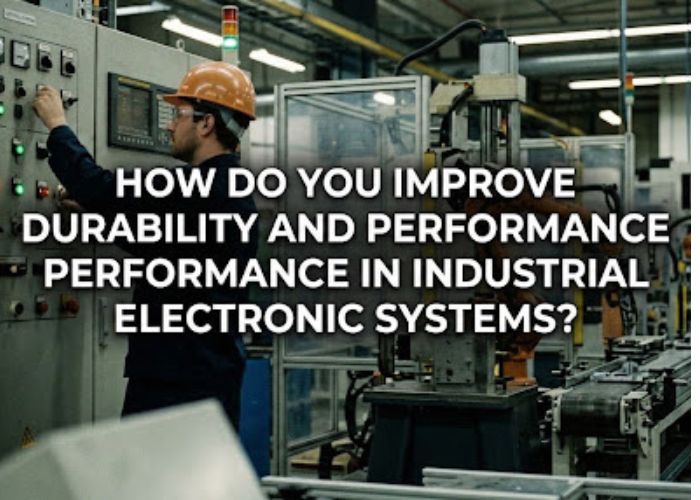
Step foot in any manufacturing facility, power substation or automated warehouse, and you’re surrounded by electronics performing menial tasks day in and day out. These systems power the motors, control the sensors, and help to keep everything of a system running often in environments that would kill a consumer device in days. Electronic environments in industrial applications are harsh playgrounds for electronic components.
So how do engineers continue to ensure these systems remain reliable, and indeed functional, for decades? It’s not one formula, but a few guidelines that always make a difference. If these are correct, a well designed system can outlast the equipment on which it operates.
Start With the Right Components for the Environment
Not all electronic components are created equal. Consumer grade capacitors are designed to operate within the ambient temperature range that is usually present in a consumer’s environment, typically up to 85°C, and are not tested for long lasting temperature exposure or high vibration levels. Industrial grade caps have tighter tolerances, are tested for higher ambient temperatures, and operate for longer periods.
It’s not an over optimization to use military spec components in a temperature sensitive control board; it’s simply engineering. The price difference is typically negligible between industrial grade and consumer grade components and the cost of a failure in the field.
Design for Thermal Management From Day One
Protect from Overheating from the Beginning with the Right Design
The number one killer of electronics is heat. If a system is in a sealed enclosure and has restricted airflow, heat is bound to accumulate and many engineers find out the hard way when a system that passed the test in the lab fails in the field.
Construction of good thermal design is thinking about airflow paths, heat sinks locations, etc., early in the design process, and not as an afterthought. Design time thermal simulation can save a lot of headaches later!
Managing Interconnect Resistance
A common source of thermal issues is the design of the interconnects. If connections are loose or not specified, they will be a source of resistance and heat. That’s why it makes sense to invest in a quality custom wire harness for the specific loads, routing and temperature requirements of your system. Do not use a “kind of fits” harness; it is a thermal and electrical hazard
Mitigating Vibration and Mechanical Stress
The vibration and mechanical stress to be protected against are indicated as follows:
Vibration in Industrial Applications is all around: from motors, compressors, conveyor belts, and from the structures where equipment is installed. It results in cracking of solder joints, loosening of connectors and mechanical failure of components over time.
Strategies for Mechanical Protection
- Conformal coating: Provides the coating which helps to minimize fatigue at soldered joints.
- Potting compounds: Do more, they can be used to seal entire assemblies in resin, so they are truly vibration-proof.
- Standoffs and strain relief: Strategically located standoffs and strain relief on connectors help to decrease stress at critical locations when boards can’t be potted.
- Component placement and mounting: Heavy components on the bottom of the board, and through hole mounting for often mated connectors, also provide some useful imperviousness.
Choose the Right PCB Technology
The traditional rigid PCBs are workhorses, but not all of the time. A flexible PCB can be a true game changer when designing solutions in tight or irregular spaces such as aerospace equipment, wearable industrial sensors, or systems with complex three dimensional routing.
Advantages of Flexible PCBs
- It fits into the available space.
- It doesn’t force the design of mechanical parts around a flat board.
- It has fewer connectors, which equals fewer failure points.
- It is capable of dynamic bending where the board must bend over a large number of times during operation.
- Flexible circuits are also lighter, which comes into play when used on mobile or airborne equipment.
Take EMI Seriously
EMF (electromagnetic interference) is an unseen disruptor. Any surrounding sensitive electronic devices may interpret as confusing signals, corrupting data, and resetting and resetting out of nowhere, or misinterpreting signals from VFD, large motors, and welding equipment.
Grounding and Shielding
The first step to good EMI management is to use proper grounding and shielding, as follows:
- Ensure signal and power grounds are separate;
- Use shielded cable for sensitive lines;
- Ensure metal enclosures are properly bonded.
Problems can be filtered at power entry points with common mode chokes and transient voltage suppressors before they reach sensitive power circuits. Filtering at design time is a much simpler task than debugging odd failures in the field later on.
Monitor, Test, and Anticipate Failure
All good systems require some maintenance over time.
In-Built Health Monitoring
In-built health monitoring converts emergency stoppages to planned maintenance downtimes through:
- Temperature sensing on critical parts,
- Current monitoring for motor degradation,
- Vibration analysis for early detection of bearing wear.
Simple threshold alarms can provide teams a heads up to plan work during downtime, not mid-production.
Rigorous Testing
Testing is just as important. Checking the lab tests at a single point is not an end in itself. Test under temperature extremes, under full-range real-world vibration profiles and at the limits of the input voltage range. Having an hour in a thermal cycling chamber can save months of field investigations.
Closing Thoughts
Making industrial electronics more durable and more performing is a disciplined and multi-layered process: picking the right components, applying aggressive thermal management, providing mechanical protection, creating a clean EMI design, and providing built-in visibility thanks to monitoring. None of these are stand-alone; they all support one another.
Not all of the most exotic or expensive systems last for very long in hard environments. They’re the ones that had someone say, “what could go wrong here?” at each step of the design, and then took some action about it. It is the attitude, not any particular technique, which makes electronics that last for ten years in a steel mill and electronics that do not make it through the first summer.